

Self-Improvement
“Anyone who always does what they already know how to do will always remain what they already are.” – Henry Ford
What Does Self-Development Mean?
Self-development refers to the changes and constants in a person’s behavior, thinking, and experiences throughout their entire life, from birth to old age. It includes physical, mental, emotional, and social aspects and considers biological factors such as growth and maturation, learning processes, and environmental influences like family, school, and culture.
A key principle is that development involves both change and stability. Some traits or abilities evolve over time, while others remain relatively constant. People also differ greatly in how they develop, as everyone grows at their own pace and in their own way.
Self-development, also called personal growth, is the process of improving yourself mentally, emotionally, and physically. It is not about being perfect but about making progress. At its core, self-development means growth instead of stagnation.
Imagine staying in your comfort zone forever. Everything feels safe and familiar, but growth does not happen there. Only when you face challenges, learn new skills, and take calculated risks do you truly develop.
Example: You fear public speaking. If you confront this fear and speak in front of a small group, your confidence will grow. Every step outside your comfort zone makes you stronger.
How Does Development Work?
Development is a complex process that results from the interaction of internal and external factors.
- Internal factors include traits within us such as genetic makeup, intelligence, personality, and personal interests. They form the foundation for development.
- External factors include influences from the environment such as family, friends, school, cultural and social expectations, economic conditions, and even historical events. These factors can create opportunities or impose limitations.
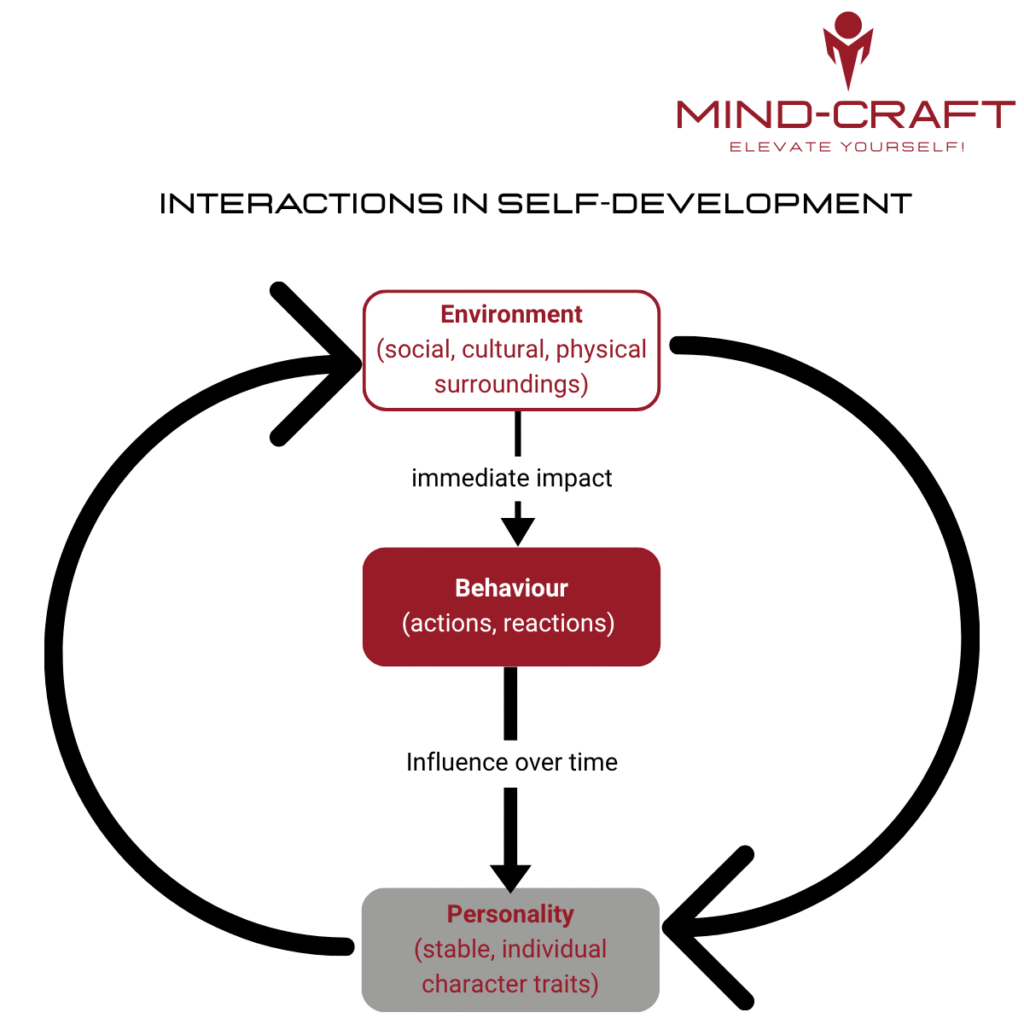
Modern theories emphasize that humans actively shape their own development. We are not simply victims of our genes or environment. Through decisions, behaviors, and goals, we can influence our growth. At the same time, the environment responds to us because our actions change the conditions in which we live.
This creates a constant interplay. We are both a product of our environment and a creator of our own world.
Example: Career development
Imagine someone grows up in a family where education is not encouraged. Environmental conditions such as low income and few academic role models might lead this person to choose a simple job. However, they decide to read extensively, pursue further education, and start a degree program. They actively seek mentors and networks. This changes their development and opens new opportunities.
Why Self-Development Matters
Personal development is the foundation for a fulfilling life. Without it, you risk feeling stuck or unmotivated. It helps you gain clarity about your goals, strengthen self-control, and unlock your full potential.
In a world full of distractions such as social media, constant comparisons, and external expectations, it is easy to lose your sense of identity. Self-development brings you back to yourself. It gives you direction and the ability to make conscious decisions that align with your true self.
Many people live far below their potential. They follow routines, meet expectations, and stay within safe boundaries. Inside, they feel empty, sensing that more lies within them but never gets awakened. Becoming the best version of yourself means unlocking this hidden potential and consciously shaping your life instead of just going through the motions.
Striving for your best version is not about perfection or comparing yourself to others. It is about strengthening your foundation by creating inner peace, clarity, willpower, and satisfaction. You build a life based on your values, independent of external circumstances, opinions, or expectations. You focus on what you can control.
Living your best version means taking charge of your life and proving to yourself what you are truly capable of. With this mindset, you pursue a fulfilling life not through comfort or chance but by striving to reach your full potential. To succeed in your career, sports, or personal life, you must learn to overcome fears, manage doubts, and cope with stress, pain, and setbacks. Only when you bring your strongest version forward can you experience true happiness and satisfaction.
The best version of yourself is not a final state but a continuous process. Every day you make a small improvement brings you closer to that version. It is a challenging journey that makes you more confident, independent, and fulfilled.
The Connection Between Development and Personality
Personality development is a lifelong process. Even in childhood, early differences in temperament and behavior appear. Over time, these differences are shaped by experiences, upbringing, education, social relationships, and societal influences.
Developmental psychology studies how personality changes throughout life, such as why some people become more relaxed with age or how crises and successes affect self-perception. It also examines how stable traits relate to life changes:
- How does high conscientiousness influence academic or career success?
- How does emotional stability affect stress management?
- How can targeted interventions such as training or therapy promote development and well-being?
Personality and development are not opposites but two sides of the same coin. Personality influences how we handle developmental tasks, and developmental processes shape our personality.
What Is Personality and How Is It Structured?
Personality is the sum of a person’s characteristic traits, thought patterns, and behaviors. It makes us unique and influences how we feel, think, and act. Personality is relatively stable but can change over time through significant experiences, crises, or intentional development.
Personality consists of several components:
- Traits: Relatively stable characteristics such as openness, conscientiousness, or sociability
- Motives and goals: What drives me? What do I want to achieve?
- Self-concept and self-esteem: How do I see myself? How do I evaluate myself?
- Interests, values, and attitudes: What matters to me? What excites me?
- Skills and competencies: What am I good at?
These components are partly innate and partly shaped by experiences and environment. To develop yourself, it is essential to observe your behavior, reflect on yourself, and become aware of these components and the need for change.
The OCEAN Model (Big Five): The Five Main Personality Dimensions
A well-known model for describing personality is the OCEAN model, also called the Big Five. It distinguishes five basic traits that every person possesses to varying degrees:
Extraversion: Sociability, energy, enthusiasm
+ pole: Talkative, energetic, assertive, outgoing
– pole: Quiet, reserved, shy, introvertedAgreeableness: Helpfulness, empathy, cooperation
+ pole: Reliable, friendly, compassionate, warm-hearted
– pole: Cold, argumentative, ruthless, competitiveConscientiousness: Reliability, organization, goal orientation
+ pole: Responsible, cautious, well-prepared
– pole: Careless, reckless, irresponsibleNeuroticism: Emotional stability versus vulnerability, stress sensitivity
+ pole: Stable, calm, content, balanced
– pole: Anxious, unstable, moody, impulsive, sensitiveOpenness to Experience: Curiosity, creativity, interest in new things
+ pole: Creative, intellectual, open-minded, curious
– pole: Simple, superficial, unintelligent, uninterested
These traits remain relatively stable in adulthood but can change through major life events or conscious development.
Leaving the Comfort Zone: Why Challenges Are Necessary for Growth
Challenging moments are not obstacles but your greatest teachers. They build perseverance, self-discipline, the ability to sacrifice, and adaptability. In these moments, you discover what you are truly capable of and gradually develop mental strength.
Leaving your comfort zone is the key to bridging the gap between your current self and your best self. Only when you accept uncertainty, resistance, and discomfort do you create the space where growth happens. Every step outside your comfort zone is a step forward in your self-development.
Your best version does not wait in comfort but where things get uncomfortable. By consciously facing challenges, you strengthen your mental resilience and lay the foundation for a fulfilling, self-determined life.
Further exciting articles on this topic can be found under Get Out Of The Comfort Zone – Theory and Leaving The Comfort Zone – Blog.
Practical Methods for Personal Growth
In addition to leaving your comfort zone, you can integrate other exercises into your daily life to foster growth:
- Negative visualization: Mentally rehearse possible challenges or losses to build resilience and appreciate what you have
- Daily journaling: Write down thoughts, experiences, and goals to gain clarity and track progress
- Evening reflection: Review your day to identify actions, decisions, and areas for improvement
- Voluntary sacrifice: Intentionally give up comfort or conveniences to strengthen discipline and self-control
- Self-observation and self-talk: Monitor your thoughts and inner dialogue to gain insight and consciously steer behavior
- Distinguish judgment from fact: Practice separating subjective opinions from objective reality to make better decisions
Example: Muscles do not grow through comfort but through strain. Likewise, your mind grows through challenges. Every obstacle you overcome makes you stronger. Self-development does not happen in one big leap but through small, consistent steps.
Mind-Craft’s Key Tools for Self-Development
Tool 1: Motivation, Willpower, and Self-Discipline
Motivation gets us moving, self-discipline keeps us going, and willpower ensures we reach our goals despite obstacles.
Motivation
Motivation is the starting point. It gives us the drive to begin, like the spark that ignites a fire. Without motivation, we lack the reason to act. Motivation often arises unconsciously and is influenced by environmental factors, so it is not constant.
Example: You want to get fitter, so you plan to eat healthier and jog more. Your motivation for training may drop if it is cold outside or you are hungry.
Willpower
Willpower is the bridge between intention and action. It helps us stay committed and make conscious decisions despite challenges.
Example: You feel like going to the movies with friends but choose to train instead because your goal of getting fitter is more important.
Self-Discipline
Self-discipline keeps you on track even when motivation fades. It ensures you stick to routines and avoid impulsive behavior.
Example: You go to the gym even when you are tired or prepare a healthy meal instead of eating fast food.
In short:
- Motivation gets you started but is situational and influenced by external factors.
- Willpower helps you make tough decisions and overcome obstacles.
- Self-discipline ensures you stay consistent and act in line with your goals.
Tool 2: Positive Stress (Eustress)
Stress is not your enemy. It can be your fuel. Positive stress, also called eustress, motivates you, boosts performance, and builds resilience.
- Why stress promotes growth: Every challenge that stretches your abilities leads to development.
- Managing stress: Recognize warning signs early, break tasks into smaller steps, practice time management, take care of your body, and maintain a positive mindset.
- Mental calluses: Just as your hands develop calluses from lifting weights, your mind becomes tougher when you regularly face challenges.
Final thought: Stress is a sign you are on the right path. Use it consciously to unlock your potential. Find out more about it: Stress.
Tool 3: Emotional Control
Our emotions are powerful. They can drive us forward or hold us back. Fear, doubt, anger, or envy often arise automatically, but whether we let them control us is up to us. Those who fail to master their emotions live reactively, driven by external circumstances and inner impulses. Those who take control live proactively, clearly, and with self-determination.
Mastering emotions does not mean suppressing them. It means noticing them consciously, understanding them, and channeling them productively. Pain, frustration, or uncertainty will not disappear, but you learn to face them with calm and strength. True freedom lies in not being a slave to your feelings but their master. Emotional control helps you develop essential qualities for becoming your best self:
- Inner stability: You remain calm even when chaos surrounds you.
- Clarity in decisions: Emotions like fear or anger no longer cloud your judgment but become signals you can interpret.
- Mental strength: Facing your feelings builds resilience.
- Self-confidence: Controlling your emotions strengthens your inner power and radiates outward.
Tool 4: Self-Reflection
Without honest self-reflection, you stay stuck in old patterns.
Questions for self-assessment:
- How do you handle stress?
- How do you respond to criticism?
- How do you talk to yourself?
- How do you deal with setbacks?
- Do you take responsibility for your life?
Tip: Keep a reflection journal to identify patterns and work on them intentionally.
Self-Development: A Lifelong, Active Process for Personal Growth
Self-development is a lifelong, active process that includes physical, mental, emotional, and social aspects. It results from the interaction of internal factors such as genetics and personality and external influences such as family, culture, and societal expectations. Modern approaches emphasize that we can consciously shape our development through decisions, goals, and behaviors while the environment simultaneously influences us.
Personal development is not about perfection but continuous growth. It requires leaving your comfort zone, overcoming fears, and dealing with stress and setbacks. Practical methods such as self-reflection, journaling, voluntary sacrifice, and emotional control support this process.
Personality forms the foundation. It influences how we handle developmental tasks and is itself shaped by experiences and intentional changes. Models like the Big Five help us understand individual differences.
The goal is not a final state but the best version of ourselves: a self-determined, fulfilling life based on our values. Every small step outside your comfort zone brings you closer to that goal.
Start today with small steps. Mind-Craft is here to support you.